News
Stay updated with the latest news from Cosmoglobe and dive deeper into our scientific results!
-
Building Connections: Highlights from the 2025 Bayesian Cosmological Data Analysis Course
Once again, young scientists from around the world convened in Oslo for two intensive weeks of studying and socializing, as the CMB&CO group at the Institute for Theoretical Astrophysics arranged their annual Bayesian Cosmological Data Analysis course.
-
Cosmoglobe DR2 now online!
The second Cosmoglobe data release, reanalyzing the COBE-DIRBE time-ordered observations, is now online!
-
The Cosmoglobe Winter Workshop 2023
In January, young scientists from all over the world came to Oslo for a week of collaboration, research and fun, as the CMB&CO group of Institute of Theoretical Astrophysics arranged the Cosmoglobe Winter Workshop 2023.
-
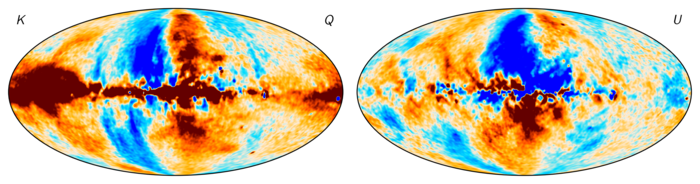
Improved WMAP sky maps in Cosmoglobe DR1
or: How I Learned to Stop Worrying and Perform Global Joint Bayesian analysis
-
Cosmoglobe DR1 products now online!
The first data release of Cosmoglobe, the first joint analysis of WMAP and Planck data, is now online!
-
Component separation course 2022
The 2022 component separation course was held in Oslo and online from 22 August - 2 September.
-
Cosmoglobe Workshop 2022
The second Cosmoglobe workshop will be held digitally from May 2–6.
-
How Polarized is Anomalous Microwave Emission?
Properly characterizing Galactic emission is vital to the future of Cosmic Microwave Background (CMB) science. Though synchrotron and thermal dust emission usually take front stage in polarization, anomalous microwave emission (AME) certainly cannot be discounted as a potential contaminant.
-
Cosmoglobe Kickoff Workshop
We are pleased to announce the first Cosmoglobe joint-experiment workshop! In this workshop, we will discuss the Cosmoglobe platform, a medium by which scientists from different radio, microwave, and sub-mm experiments can share raw data to allow for the best possible extraction of data using different data collection methods.
-
Release Conference November 18-24
Microwave observations have, during the last half century, transformed cosmology, and helped to establish a highly successful model of the universe. However, the signals which the next generation of experiments are searching for are extremely weak and thus difficult to detect. To make further progress researchers need to have exquisite control of all relevant sources of systematic uncertainties, whether they are of instrumental or astrophysical origin.